
AI Automation & Intelligent Workflows: Transforming Modern Business Operations
Discover how AI automation and intelligent workflows are revolutionizing business processes by enabling smarter decisions, reducing manual work, and creating scalable, data-driven systems that learn and improve over time.
Introduction
Businesses today operate in a fast-paced digital environment where speed, accuracy, and efficiency define success. Traditional automation helped reduce manual work, but it lacked intelligence. Now, with the rise of Artificial Intelligence (AI), organizations can build intelligent workflows that not only automate tasks but also analyze data, make decisions, and continuously improve performance.
AI automation is reshaping how companies operate — from customer service and sales to finance and HR.
What is AI Automation?
AI automation refers to the integration of artificial intelligence technologies into automated systems. Unlike rule-based automation that follows predefined instructions, AI-powered systems can:
Understand data patterns
Make context-aware decisions
Predict outcomes
Adapt based on new information
Instead of simply executing commands, AI systems evaluate situations and respond intelligently.

What Are Intelligent Workflows?
An intelligent workflow is an automated process enhanced with AI capabilities. It connects multiple systems, analyzes incoming data, and triggers actions without human intervention.
An intelligent workflow typically:
Captures data from various sources
Processes and analyzes that data
Makes a decision based on insights
Executes the appropriate action
Learns from results to improve future outcomes
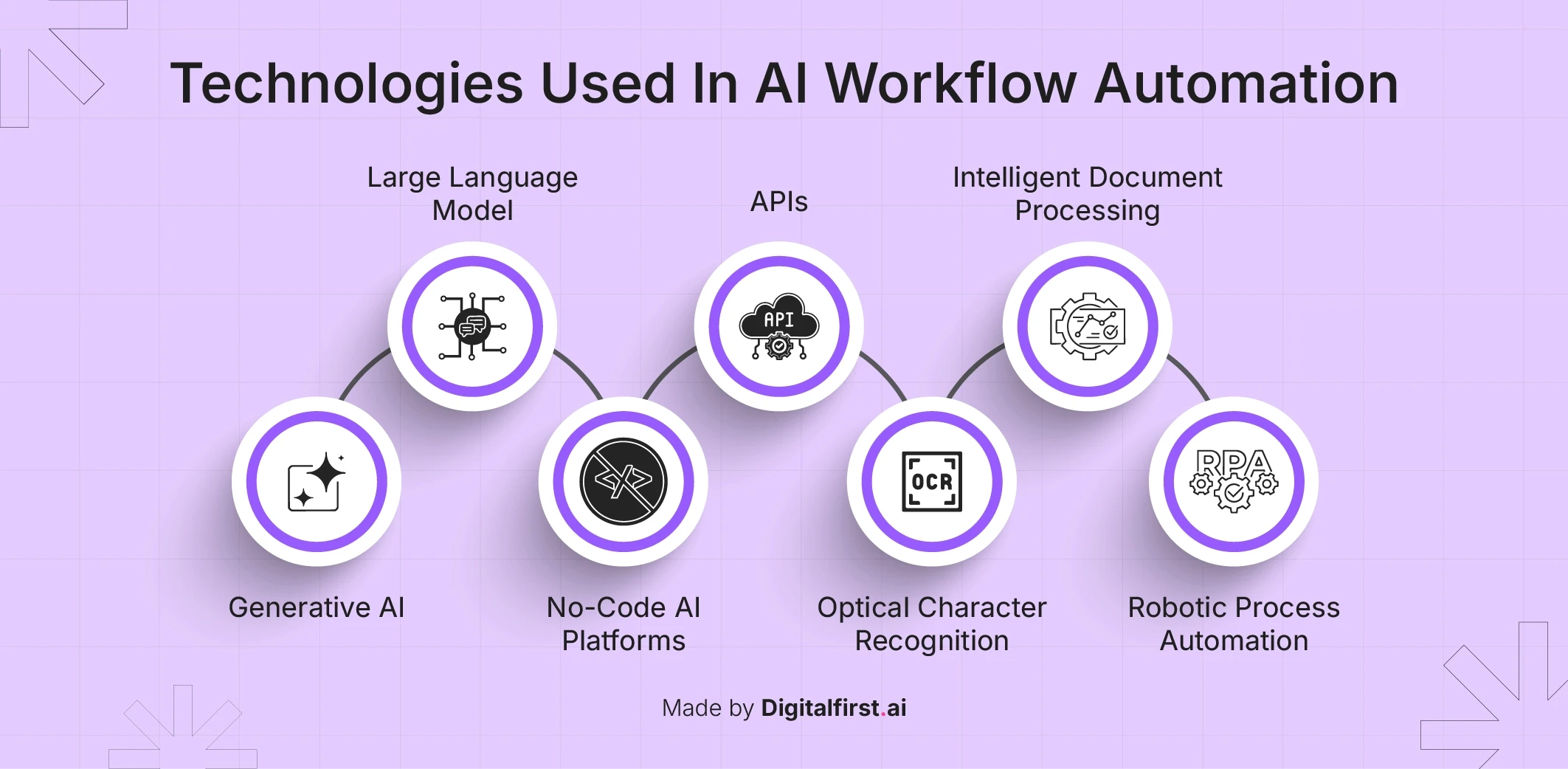
These workflows integrate tools such as CRM systems, email platforms, databases, cloud services, APIs, and AI models into a seamless operational pipeline.
Real-World Applications
1. Smart Customer Support
AI systems can classify customer queries, generate automated responses, escalate complex issues, and update support dashboards all in real time.
2. Automated Sales Pipelines
Leads can be captured, scored using predictive models, assigned to sales representatives, and followed up automatically with personalized communication.
3. Intelligent Document Processing
Invoices, contracts, and forms can be scanned using OCR, validated by AI, and processed without manual review.
4. HR & Recruitment Automation
AI can screen resumes, rank candidates, and schedule interviews automatically, significantly reducing hiring time.
Benefits of AI Automation
Increased Efficiency: Eliminates repetitive tasks
Improved Accuracy: Reduces human error
Scalability: Handles high workloads effortlessly
Cost Savings: Optimizes operational expenses
Better Decision-Making: Uses real-time data insights
Organizations gain a competitive edge by turning data into actionable intelligence.
AI Automation vs Traditional Automation
Traditional automation relies on fixed rules. AI automation, however, is adaptive and data-driven. It evolves with new data, improves accuracy over time, and handles complex decision-making scenarios that rule-based systems cannot manage.
Challenges to Consider
While powerful, AI automation requires:
High-quality data
Proper monitoring and governance
Secure infrastructure
Ethical AI practices
Strategic implementation is key to maximizing value.
The Future of Intelligent Workflows
The future of business lies in autonomous systems, AI copilots, predictive decision engines, and hyper-automation across departments. Organizations that adopt AI-driven workflows early will lead in innovation, productivity, and operational excellence.
Conclusion
AI Automation & Intelligent Workflows represent the next evolution in business operations. By combining intelligence with automation, companies can unlock efficiency, scalability, and smarter decision-making.
The goal isn’t to replace humans it’s to empower them.